

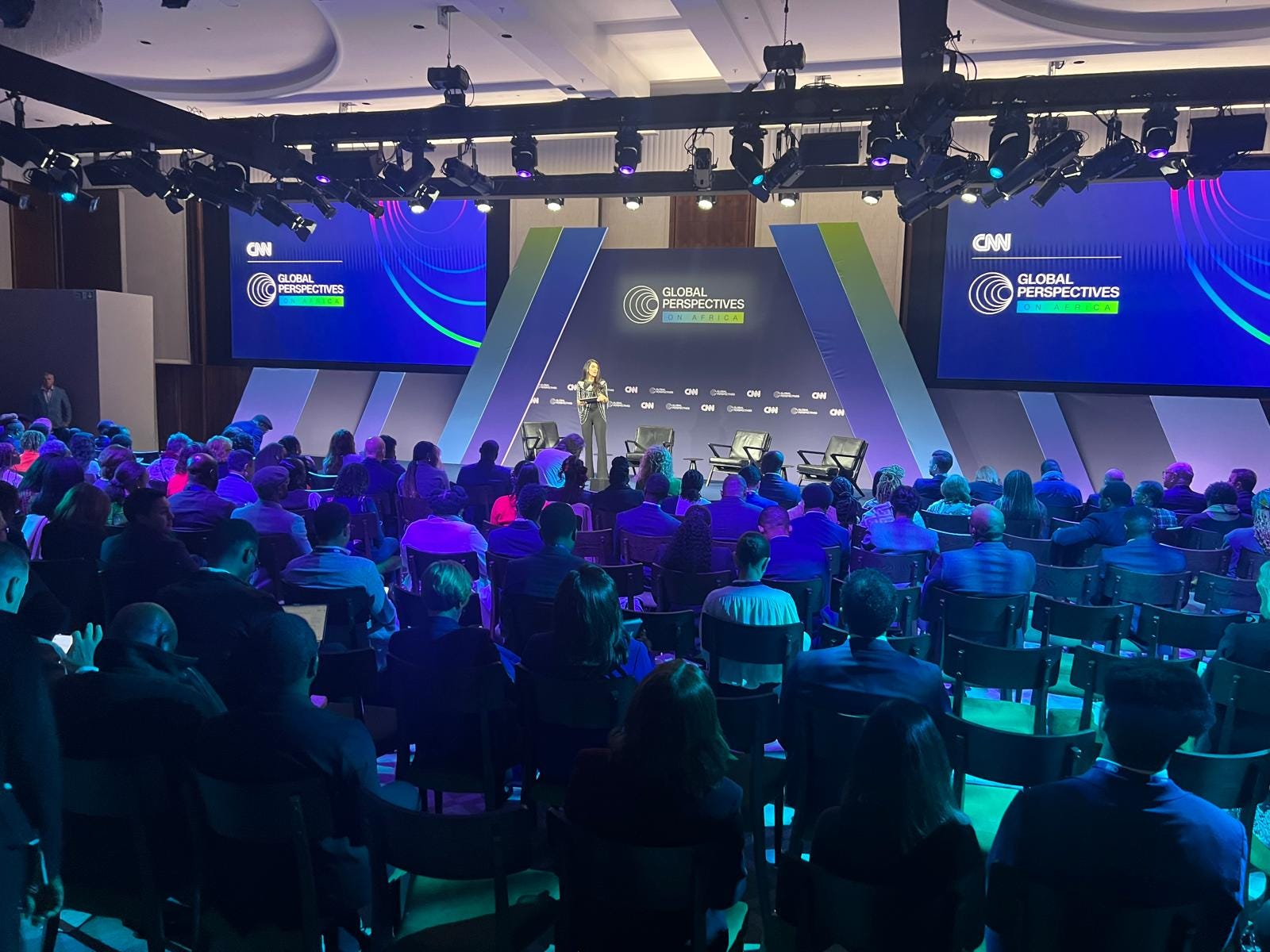
I was at the CNN Global Perspective Summit this week, and the air was thick with a single, massive question: What’s next?
The room was filled with top African leaders, investors, and policymakers. The conversation, as it always does, turned to growth.
A live poll flashed on the screen to vote on what we think will drive Africa’s growth in the coming years.
The answers came in. The #2 response? Artificial Intelligence.
There was so much excitement in the room. You could feel the ambition. The potential. A sense of a continent not just catching up but poised to lead.
But something Tony O. Elumelu said resonated deeply with me: “How can we scale AI when we have not sorted the issue of energy?”
His question highlighted the big “but” that hangs over every conversation about Africa’s potential.
The energy grid. Data costs. Basic connectivity.
How can a continent scale AI if the lights won’t stay on?
It’s a valid, critical, and heavy question. It’s the bottleneck that has defined a thousand similar conversations. I agree that infrastructure is one of the challenges. But the real bottleneck—and the real opportunity—is the untapped potential of the African youth. If we can just harness it.
The most important, complex, powerful software on the planet is the human brain. And if we can harness this, Africa could truly lead.
As I shared what we’re building at Readie AI, with those I could, on how we assess and build the human readiness for this new age, I noticed the conversations lit up.
There are different policies in flight and many infrastructure projects underway that will turbo-charge Africa’s growth if we collaborate well together but here is a kicker - you can have all the connectivity in the world and still fail, because the major bottleneck isn’t the power grid.
It’s the human grid.
It’s the gap between “having” AI and “using” AI. It’s the gap in skills, in confidence, in process, in psychological safety .
And as I stood there, it hit me. This isn’t just a gap. It’s the single greatest opportunity of the 21st century.
This realisation wasn’t just a feeling. It’s a mathematical certainty.
Let’s look at the numbers, because they are staggering.
Africa’s economy is forecast to grow 1% faster than the rest of the world next year. The momentum is already here.
By 2050, the continent will be home to 2.5 billion people.
Because of that, Africa will have 22% of the entire world’s working-age population.
Think about that. One in every five workers on Earth will be in Africa.
An un-skilled workforce of that size is a global crisis. A skilled one is the engine for the entire planet.
Now, add the “hardware” back into the equation. The continent has:
30% of the world’s rare earth minerals—the very materials needed to build our AI and tech future.
67% of the world’s arable land—a resource that can only be unlocked at scale with AI-driven agricultural technology.
This is what got me so excited. This is the “AI First” mindset I wrote about in my book, but at a continental scale .
The continent has the raw materials (the minerals) and the human potential (the workforce). AI is the catalyst that connects them.
This is why I’m building Readie AI.
Because the challenge isn’t just if AI will be adopted, but who gets to participate.
The leaders at that summit were right—there are many challenges to be solved to harness Africa’s potential but a significant one that will define the next 50 years, is the race for talent.
It’s about making AI a national skill, not a spectator sport.
The future of Africa’s growth isn’t just in its mines or its soil. It’s in the minds of its people. The mission now is to make them ready.
Thank you for being part of the ‘inner circle.’
Feel free to share this post.